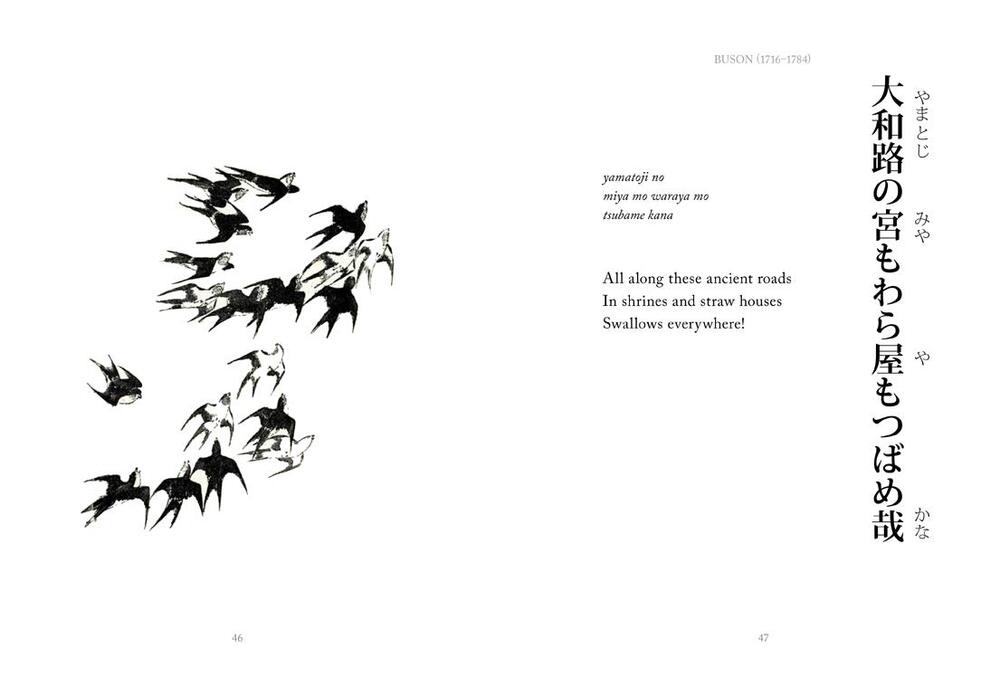
Today I picked up a book of haiku that includes the original Japanese w/English translations. I'm trying to improve my appreciation for poetry (I like classic literature, but I've always thought of poetry as kinda "lame" so I decided I should give it another chance). When I saw the book of 俳句 I thought ... well, 一石二鳥 ... でしょう?
I'm hoping to gain some insight into what makes a "good" haiku (apart from simply following the construction "rules"). I find the use of 季語 interesting, which from my understanding are a bit like keywords for certain seasons (桜=spring, 蝉=summer, 月=autumn, etc). However, I'm still trying to wrap my head around the 切れ字 thing ???
So I was wondering ... does anyone out there have a favorite haiku?
Or how about a favorite proverb/ことわざ/四字熟語?
I've always liked 猿も木から落ちる (even monkeys fall from trees) and 井の中の蛙、大海を知らず (the frog in the well does not know the great sea). And my favorite 四字熟語 is the one I use for my hanko - 暗中模索 ... story of my life ;)
I think my favorite 四字熟語 would have to be 十人十色, 'ten people, ten colors' - basically it means 'to each his own,' or 'one man's trash is another man's treasure;' that everyone has their own likes and dislikes.
4
14 years ago
Level:
My favorite proverb is 「塵も積もれば山と成る」, because I think of it every time that I realize that I still don't know jack about Japanese.
[quote author=valymer link=topic_id=5266&post_id=25417#rmsg_25417 date=1330842366]My favorite proverb is 「塵も積もれば山と成る」, because I think of it every time that I realize that I still don't know jack about Japanese.[/quote]
I like that one ... I really hope there's truth to it :)
It reminded me of another that's similar - 雨垂れ石を穿つ (constant drops of water can eventually bore through stone). I'm not sure whether I think Japanese is more like an enormous mountain or impenetrable rock ;)
Nothing appears more surprising to those, who consider human affairs with a philosophical eye, then the easiness with which the many are governed by the few; and the implicit submission, the with which men resign their own sentiments and passions to those of their rulers. When we inquire by what means this wonder is effected, we shall find, that, as Force is always on the side of the governed, the governors have nothing to support them but opinion. it is therefore an opinion only that the government is founded; and this maxim extends to the most despotic and most military governments as well as to the most free and most popular
多美子 (02月27日, 0:26)
Today I picked up a book of haiku that includes the original Japanese w/English translations. I'm trying to improve my appreciation for poetry (I like classic literature, but I've always thought of poetry as kinda "lame" so I decided I should give it another chance). When I saw the book of 俳句 I thought ... well, 一石二鳥 ... でしょう?
I'm hoping to gain some insight into what makes a "good" haiku (apart from simply following the construction "rules"). I find the use of 季語 interesting, which from my understanding are a bit like keywords for certain seasons (桜=spring, 蝉=summer, 月=autumn, etc). However, I'm still trying to wrap my head around the 切れ字 thing ???
So I was wondering ... does anyone out there have a favorite haiku?
Or how about a favorite proverb/ことわざ/四字熟語?
I've always liked 猿も木から落ちる (even monkeys fall from trees) and 井の中の蛙、大海を知らず (the frog in the well does not know the great sea). And my favorite 四字熟語 is the one I use for my hanko - 暗中模索 ... story of my life ;)
I am also not into poetry, but I enjoy the haiku prompts here.
What is the book called? I love books with the translations in them.
@Robinsparrow1 I'm also curious, but that post is from 14 years ago so we might not get an answer :D You could try something like "Haiku Illustrated: Classic Japanese Short Poems":
I like the more (early) modern authors, for example Chūya Nakahara (poetry) and Masaoka Shiki (haiku). Been trying to use 季語 and 切れ字 better lately.
For proverbs, I'll go with 鬼が出るか蛇が出るか or 甘い物は別腹
For idioms, I like 馬脚を現す, 墓穴を掘る, and I recently learned 氷山の一角 which feels like it got lifted from English.
@Robinsparrow1 I'm also curious, but that post is from 14 years ago so we might not get an answer :D You could try something like "Haiku Illustrated: Classic Japanese Short Poems":
I like the more (early) modern authors, for example Chūya Nakahara (poetry) and Masaoka Shiki (haiku). Been trying to use 季語 and 切れ字 better lately.
For proverbs, I'll go with 鬼が出るか蛇が出るか or 甘い物は別腹
For idioms, I like 馬脚を現す, 墓穴を掘る, and I recently learned 氷山の一角 which feels like it got lifted from English.
Drifting a mite from the subject to drop two resources for Japanese poetry which I find very helpful: haiku-textbook.com and tankanokoto.com. (Which I had meant to drop in another related thread, but then I forgot which one it was.)
My actual grasp of Japanese is... well, nothing much. But with these websites, I love to spend time delving into individual haikus and learning about all their implications. I'll forget them again and again, it's not "practical", and it probably doesn't advance my learning process effectively, but I love it.
(Will try to pick a favourite or two, but it's so hard to choose.)