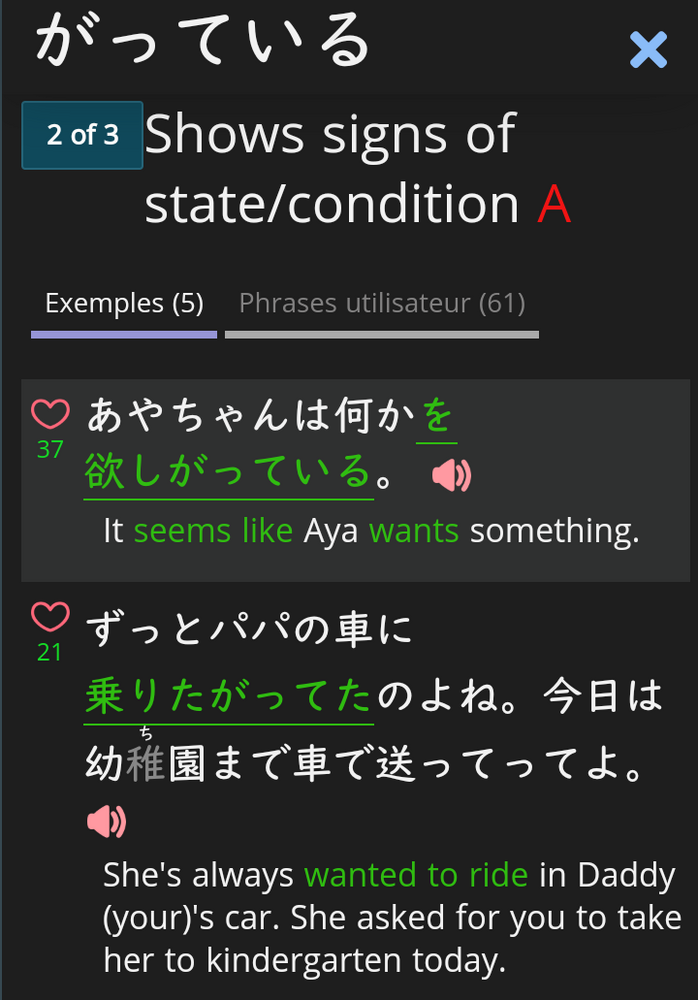
About the second usage, by referring verbs which represent a state/condition (like 疲れる、混乱する、怒る, etc.), isn't it still possible to use it with verb? For instance, saying '怒りたがっている' doesn't always mean '(seems) want to angry' but means 'seems angry' instead. Then how about 疲れたがる, does it always means 'seems want to get tired'? I believe it's roughly depend on context, though. So how do you think?
About the second usage, by referring verbs which represent a state/condition (like 疲れる、混乱する、怒る, etc.), isn't it still possible to use it with verb? For instance, saying '怒りたがっている' doesn't always mean '(seems) want to angry' but means 'seems angry' instead. Then how about 疲れたがる, does it always means 'seems want to get tired'? I believe it's roughly depend on context, though. So how do you think?
I've never heard this grammar pattern used in this way; usually, if you want to say someone seems angry/tired etc, you hear things like 怒っているらしい、疲れているようです、混雑しているみたい。Not to say the above *can't* be used, just that if it can, it's probably a rarer usage... But especially since the ~たい form is in there for verbs, it would seem to lead one to believe that the condition is desired, like you said - one wants to become angry, one wants to be tired...
I guess you're right. Another one, are these count as the second usage (or the third?) too?
暑がり is sensitive to heat
寒がり is sensitive to cold
怖がり is coward
when「屋(や)」attached, it'd mean the 'type of the person that (sensitive to...)'; it doesn't seems work with all adjective, though.
And for 強がる, does it always means "pretend to be tough" (negative nuance) and not "seems strong" (does not contain negative nuance)?
I would say the ~がり is most similar to usage 2, but I'm not sure if I'd put them together in the same thing.
with 強がる, it's not something that I've personally heard too often, but I would say that it would more have the pretending connotation - if you wanted to say someone seems strong, I'd go more with 強そう