Vocabulary dictionary

Kanji dictionary

Grammar dictionary

Sentence lookup

test
 

Forums - What's the difference?

Top > 日本語を勉強しましょう / Let's study Japanese! > Anything About Japanese


avatar
Karlla
Level: 910

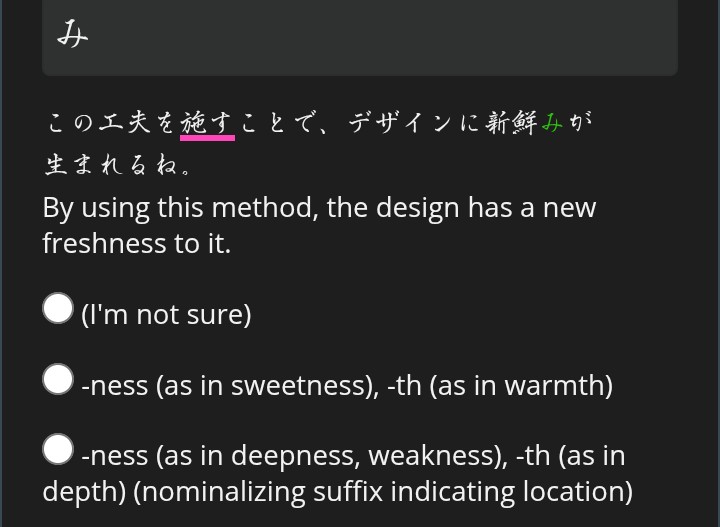
Can someone please explain to me what the difference between these two options is?

And maybe also how "location" comes into play here?

aa84e4737ff0787f1bb17824.jpg
0
1 day ago
avatar

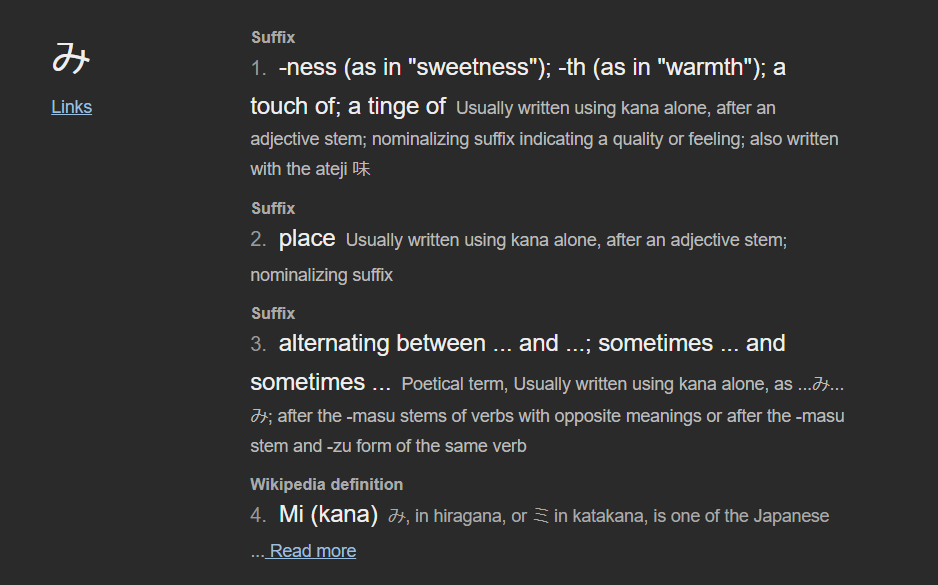
The first one refers to a "quality" or "feeling", e.g. 甘み / 苦み or 温かみ. "also written with the ateji " (from Jisho).

The second one refers to things like 高み or 低み, which are "places" / "locations".


I'm not sure exactly why they're separate, but that's the difference.


Edit: I mean... I guess technically they aren't the same ~み kao_question.png

Jisho tends to get updated a lot more (both usually pull from JMdict), so this might be more accurate?

f59eb9ca1e1e73a428e1dfe4.png

The "weakness" / "deepness" part is pretty confusing... feels like it should maybe be grouped with #1 ?

I guess you could say みをむ, where 弱み *is* different than something like 甘み? It's a more concrete "thing", whereas み is just a quality?

0
1 day ago
avatar
Karlla
Level: 910

Thanks for the clarification (although it's still rather unclear to me). The way it is split here on renshuu is very confusing.


On a tangent, I've always understood み as an "emotional" nominalizer and さ as a more "objective" one. So み = depth (e.g. in the meaning of a poem or the character of a person) さ = physical, measurable depth. So I don't fully grasp how み etc. pertain to "location".

0
1 day ago
avatar
Karlla (084, 7:25)

I've always understood み as an "emotional" nominalizer and さ as a more "objective" one.

​That works in a lot of case, but is an oversimplification that breaks down quite easily. み is simply the "sweetness" of food, nothing "emotional" about it. さ is similar, but the difference is that み is the general concept of "sweetness", while さ is the "degree" of sweetness.


How does み pertain to "location"? That's actually its original meaning, "a high place". A "high place" IS a physical location. み in something like 高みの見物 very much refers to a physical place, even though the expression is usually metaphorical.

And then 高さ is basically the degree/amount of being "high" or "tall".


み」: むこと、んでいるにあること = Pain, in a state of pain
さ」: どれだけんでいるかの = A state indicating how much pain, an amount

[Source for these two]


So み refers to the phenomenon itself, while さ treats "painful" as a scale. Does that make sense?


PS: I think the "emotional vs objective" distinction is more of a byproduct. Many ~み nouns are also used metaphorically, so they can feel more subjective, but that comes from the base adjective and the nuance of ~み, not from ~み itself being "emotional".

Something like a みショートボブ (hairstyle) is far from anything "emotional" or "subjective", or a feeling at all. It's just a quality/aspect that something possesses.

Note that the secondary meaning of 丸み is a metaphorical extension built on top of the literal one.

0
1 day ago
avatar
#のキツネ
Level: 13

If its been ages and youve forgotten basicly everything i would restart but otherwise see if you still know enough to keep going

0
1 day ago
avatar
火のキツネ (084, 13:12)

If its been ages and youve forgotten basicly everything i would restart but otherwise see if you still know enough to keep going

​I think you meant to reply to the "coming back to learn after a while, should I restart?" topic not this one kao_question.png

1
1 day ago
Getting the posts


Top > 日本語を勉強しましょう / Let's study Japanese! > Anything About Japanese


Loading the list
Lv.

Sorry, there was an error on renshuu! If it's OK, please describe what you were doing. This will help us fix the issue.

Characters to show:


Use your mouse or finger to write characters in the box.
■ Katakana ■ Hiragana