掲示板 Forums - No One Teaches Useful Japanese - Am I Crazy?
Top > 会話 / General discussion > General Discussion
Maybe I'm crazy, but it seems difficult to find Japanese language resources that teach 'useful' Japanese. Vocab and grammar you'd use if you're visiting or especially, living here. I've finished Genki 1, but I still can't make a reservation at a hotel, order at a restaurant, or buy a train ticket. But I can say my grandmother was tired yesterday. Why? Who and why did someone decide this is the critical beginner Japanese I need to know first? I don't even say this in English.
This issue seems ubiquitous and I'm not sure why. I also seem to be the only one who has this problem, so I admit it's probably a me issue. I live in Japan and I really prioritize daily living Japanese. It's not just Genki but almost every resource, including Renshuu, does this. I admit it's been frustrating because I go to study a resource, and it's having me practice sentences like "学生は寮へ帰ります。 The students will return to the dorms." This is from Renshuu's 'Japanese Basics'. I understand the point is that it's teaching 行く・来る・帰る,
but why not use useful Japanese instead of kanji no one is going to know and will likely never use? It's discouraging and feels like I'm wasting my time. Why not something like "私は京都へ帰ります。" instead? It serves the same function, but uses Japanese and Kanji both a visitor and someone living in Japan should know.
The only textbook I've seen that covers useful Japanese is Irodori, which is basically the Japanese government's own textbook. I'm curious your thoughts. I love Renshuu and bought a lifetime membership awhile ago. I hope it doesn't seem like I'm being too negative lol.

I think that's a perfectly valid criticism. The response I tend to give when this comes up is that you (not you specifically, but the general you) are not the same as others, and when given the goal of "a whole language", there is *no* objective ordering of words/phrases that can be considered optimal for all (or even most) learners.
To use some of the data you mentioned in your post, you are living in Japan, so I'm going to guess that you are not studying here. So already, what you need is vastly different from someone who might live 10 km away from you in the local university, or someone who is working next door in a restaurant.
Some people have no desire or intention to visit Japan, and are perfectly happy and content to consume media. For them, "returning to Kyoto" might be "useless", but as they happen to love slice-of-life anime, knowing all the terms that are used in schools here, or learning phrases used by senpai/kouhai might be useful.
This may not play out to all of the other examples you could pluck from renshuu, but "the students return to the dorm" is a great way to get a few extra vocabulary words out there. If one approaches it from a minmaxing standpoint, then one might think "well, I'm going to be saying 私 or I'm going to be using people's names. Get all those other people nouns out of there! I can learn them later." That can lead to a more myopic view of the langauge, and creates a set of rails of sorts. By that, I mean that if you optimize for only the things you see immediate use for, it can be *great* as long as you are inside of those rails. As soon as you take a detour into an unexpected conversation, it feels like your Japanese no longer exists (I experienced this countless times during the first several years in the country).
In defense of Genki, I would argue that while you might not be getting a "I can use this right now" feel from every word, it gives flavor to the material that makes it easy for many people (not all, of course) to stick with it. As silly as it was, me and my classmates in Uni enjoyed joking about Mary and Takeshi's relationship throughout the course of the two genki texts, wondering if they'd ever start dating.
At the same time, other people will subjectively feel that approach is terrible, and they want (if we're talking vocabulary) the first 6000 words ordered by frequency of use, and they'll just ingest them directly. No flavor/context needed.
Is either group wrong? Of course not.
What it sounds like you are looking for (and I'm glad to hear that irodori fits that) is survival Japanese. It tends to focus more on "pre-packaged" phrases that you can bust out and use. For those that benefit more from that, they tend to have a timer of sorts hanging over their heads, in the sense that they need to be able to use that Japanese sooner than later.
What renshuu and genki and many other textbooks do is approach it from a "you're in this for the long run. We unfortunately cannot fully customize every word list/phrase set/grammar for your specific needs, so we're going to teach you the fundamentals while giving you a broad selection of many different areas.
A "jack of all trades, master of none" approach.
In short, "useful" is a surprisingly subjective word, and so there will never be a day when learners can get together and come up with a single list of set of lists of useful words (or grammar or whatever) that works for everyone.
You may want to consider adding a sentence schedule to study specific areas of interest:
For example to study ordering food at a restaurant, there is this set of Sentence lists:
Resources -> Community Lists -> Sentences ->
Food (2 Lists)
Restaurant Phrases - #1 - Getting seated (9 sentences)
Common phrases you can use/will hear when at a restaurant. Part 1 - getting to the table!
Restaurant Phrases - #2 - Ordering and Leaving (16 sentences)
Useful phases to get the food from the kitchen to your mouth!
I think that's a perfectly valid criticism. The response I tend to give when this comes up is that you (not you specifically, but the general you) are not the same as others, and when given the goal of "a whole language", there is *no* objective ordering of words/phrases that can be considered optimal for all (or even most) learners.
To use some of the data you mentioned in your post, you are living in Japan, so I'm going to guess that you are not studying here. So already, what you need is vastly different from someone who might live 10 km away from you in the local university, or someone who is working next door in a restaurant.
Some people have no desire or intention to visit Japan, and are perfectly happy and content to consume media. For them, "returning to Kyoto" might be "useless", but as they happen to love slice-of-life anime, knowing all the terms that are used in schools here, or learning phrases used by senpai/kouhai might be useful.
This may not play out to all of the other examples you could pluck from renshuu, but "the students return to the dorm" is a great way to get a few extra vocabulary words out there. If one approaches it from a minmaxing standpoint, then one might think "well, I'm going to be saying 私 or I'm going to be using people's names. Get all those other people nouns out of there! I can learn them later." That can lead to a more myopic view of the langauge, and creates a set of rails of sorts. By that, I mean that if you optimize for only the things you see immediate use for, it can be *great* as long as you are inside of those rails. As soon as you take a detour into an unexpected conversation, it feels like your Japanese no longer exists (I experienced this countless times during the first several years in the country).
In defense of Genki, I would argue that while you might not be getting a "I can use this right now" feel from every word, it gives flavor to the material that makes it easy for many people (not all, of course) to stick with it. As silly as it was, me and my classmates in Uni enjoyed joking about Mary and Takeshi's relationship throughout the course of the two genki texts, wondering if they'd ever start dating.
At the same time, other people will subjectively feel that approach is terrible, and they want (if we're talking vocabulary) the first 6000 words ordered by frequency of use, and they'll just ingest them directly. No flavor/context needed.
Is either group wrong? Of course not.
What it sounds like you are looking for (and I'm glad to hear that irodori fits that) is survival Japanese. It tends to focus more on "pre-packaged" phrases that you can bust out and use. For those that benefit more from that, they tend to have a timer of sorts hanging over their heads, in the sense that they need to be able to use that Japanese sooner than later.
What renshuu and genki and many other textbooks do is approach it from a "you're in this for the long run. We unfortunately cannot fully customize every word list/phrase set/grammar for your specific needs, so we're going to teach you the fundamentals while giving you a broad selection of many different areas.
A "jack of all trades, master of none" approach.
In short, "useful" is a surprisingly subjective word, and so there will never be a day when learners can get together and come up with a single list of set of lists of useful words (or grammar or whatever) that works for everyone.
Doesnt travel revolving the word kyoto have weird wordings depending on if you're from there/not? Like w/ up vs down being flipped?

If you're looking for "everyday" Japanese, I might be able to recommend a textbook to you. It's called Situational Functional Japanese and deals with common scenarios like introductions, doctor's visits, restaurant orders, and so many more. The book provides vocabulary lists, model conversations, and grammar notes for each scenario. I have the second volume, but I'm not sure how many there are in total. Here's a picture for reference:
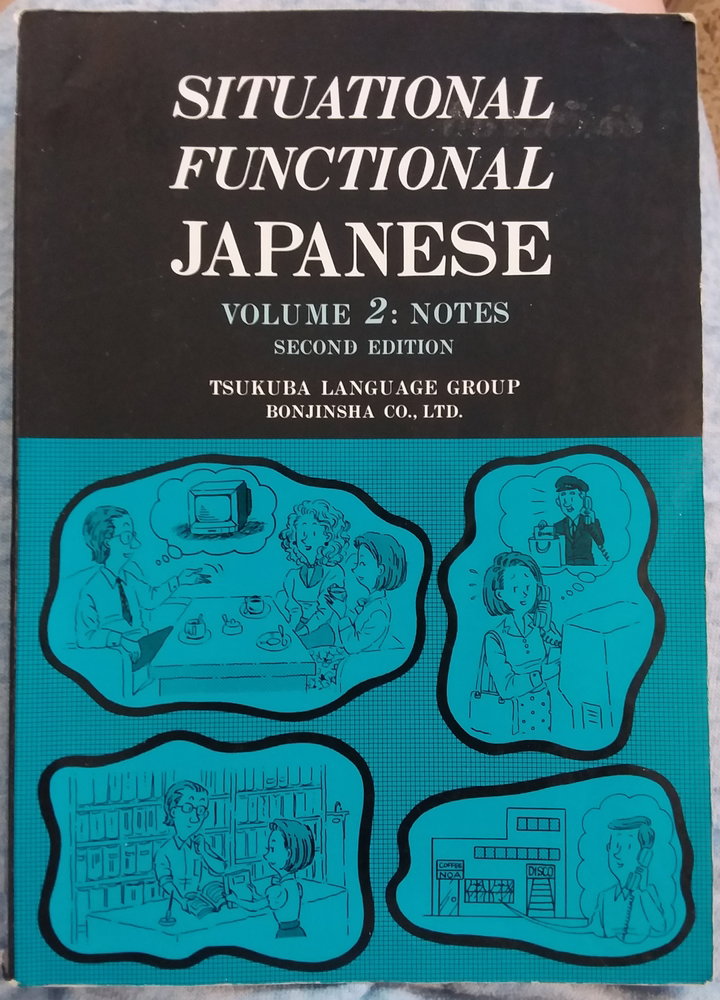
I hope this helps! 
Because you can't teach Japanese that will "feel useful" or even "be useful" for everyone. Whatever you try to do, it will be always not useful for some people. Some ressources may teach you things that feel more useful than others but there are no ressources that will teach only useful for you.
So just don't expect anything from those ressources. It still important, or "efficient", to study with those ressources for the long term but if you want to get ride of that "not learning useful things", search for a few things that you want to say and add to them a custom schedule. Like, look for few channel related to your interests with JP subtiles, watch a couple of video or short and then start adding a few words/sentences to a custom schedule to study them. Then rinse and repeat.
A lot of people "only" study with those generic ressources, common words list, etc. and end up frustrated at some point because they still can't have basic conversation after a few years, or even more. But that's normal. All of them are designed with a "jack of all trades, master of none" approach like マイコー said. It's useful for the long term but it will also never be enought for any "basic" conversation besides greetings. Because as soon as you're past the greetings, you will need more specific things, uncommon words, etc. Like for talking about your hobbies in details. It won't stop at "What are your hobbies?" and you listing your hobbies. People will ask details about them, why you like them, etc.
Basically, you need to "complete" your japanese, or customize it. And Renshuu can allow to do that quite easily with the schedule system, the community list, etc.
ALSO, it doesn't mean do "more". It mean do "less" with those ressources and give yourself some time to study what you want or need. For example, watch some vlogger in your case (for that part "I still can't make a reservation at a hotel, order at a restaurant, or buy a train ticket"). There a tons of them on youtube with JP and EN subtitles.

all these responses are excellent. ill add a little bit from my perspective. i think otuside japan, people learning phrases they can work on that are more relevant to grammar points or topics that are for outside japan like ur example talk about family or something. priority to new person learning japanese outside of japan overall is probably not to immediately travel to japan and need words like 乾燥機,but u need that ur first week in japan when u are at laundromat or if u have fancy place where u do not need to hang clothes. "survival phrases" are useful but there are more specialized books for them. i have my own notes on things from ordering food to taking transpiortation, but other thing to think about is that those phrases and words you learn very quickly out of necessity when in japan. your first day or two neway u learn difference between 出口●入口 上り階段●下り階段 持ち帰り●店内飲食 or hear words like レジ袋はいりますか at konbini and understand what they mean.
i do think that it would be nice if more books and courses had this type of focus, but like u said books in japan have things like that already. and there are phrasebooks and japanese language books specifically targeted at this type of words and set phrases. and some of these phrases can use keigo and other concepts so arent too useful to beginner from grammar study perspective. like at konbini u might hear レジ袋はご利用になりますか but beginner book why teach ご + になる 尊敬語 patterning seems a bit much. u still learn word in beginner for bag, 袋 so when u at konbini and hear word 袋 followed by か u can assume cashier asking do u want bag. another example, u live in japan, u sort trash or even as tourist with bottle, u need to know PET/ペットボトル is plastic bottle, but even in english not many ppl know polyethylene terephthalate (i had to look up spelling of that). but ur first time in japan u see the icon of bottle, then read word above it, and say oh ペットボトル is PET and thats plastic polyethylenesomethingiforget 
so these kind of words i think better for specific phrasebooks or living in japan books. there are similar books for learning japanese for businesspeople (even old pimsleur courses were about business meeting contexts and staying at fancy hotels). genki is made for students in a classroom outside of japan, thats y u arent seeing a lot of japan-specific "daily life" words or set phrases, especially bcuz u learn them quickly once u in japan.
Top > 会話 / General discussion > General Discussion